From 200 Documents to 1 Timeline: How Brieflee Reconstructs Your Case
Building a chronology from a large case file takes days of manual work. Brieflee reconstructs the full timeline from your uploaded documents, links every event to its source, and flags what's missing — so you can focus on legal strategy instead of data extraction.
7 min read
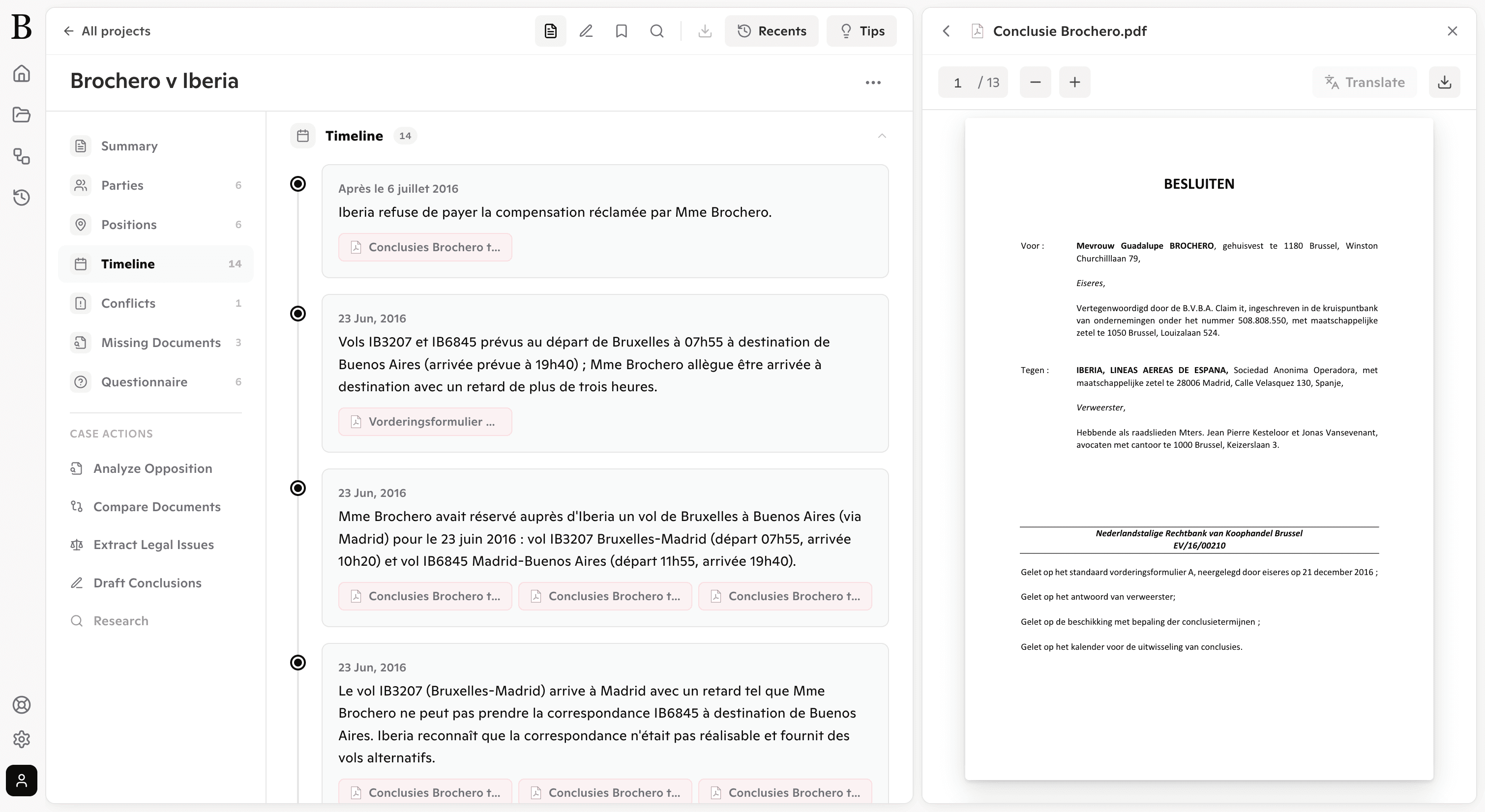
The most time-consuming task in litigation is also the most mechanical. We built Brieflee to handle it.
Every litigator knows the drill. A new case comes in with contracts, emails, invoices, memos, court filings, expert reports — sometimes dozens, sometimes hundreds of documents. Before you can form a legal position, you need to understand what happened, in what order, and what might be missing.
That means reading every document, extracting dates and events, cross-referencing them in a spreadsheet, and checking for gaps. In a complex commercial dispute, this takes days. In construction litigation or multi-party cases, it can take weeks.
Most of that work is mechanical — not legal. You are not applying judgment when you note that a letter was sent on March 12. You are extracting structured information from unstructured documents.
That is exactly what we built Brieflee to do.
The Problem Brieflee Solves
A case chronology is not optional in Belgian litigation. Written conclusions (conclusies/conclusions) require a coherent factual narrative. Courts expect clarity. Opposing counsel will exploit any gap you miss.
Yet the process of building one has not changed in decades:
Reading time. A 200-document file can take 15–25 hours just to read through.
Manual extraction. For each document, you identify dates, parties, actions, and obligations. Repetitive, error-prone, especially late in the day.
Cross-referencing. The email from April 3 relates to the contract amended on March 28 and the invoice disputed on April 15. Making these connections requires constant back-and-forth across documents.
Noticing what's not there. This is the hardest part. A referenced letter that was never produced. A five-month gap with no communication. A statutory notice with no evidence of delivery. You cannot search for what is missing.
How Brieflee Builds a Case Chronology
With Brieflee, you upload the case file and the system processes all documents simultaneously — building the timeline across the entire file at once, not document by document.
Step 1: Upload your case file. Drag your documents into a Brieflee project — PDFs, Word files, scanned correspondence, emails. Brieflee processes each document, including OCR for scanned materials. There is no reformatting or preparation needed.
Step 2: Brieflee extracts dates and events. Across all documents, Brieflee identifies temporal markers: explicit dates, relative references ("three weeks after delivery"), deadlines, and periods. Each date is linked to the event it describes and the parties involved.
Step 3: Cross-document connections. This is where Brieflee adds the most value. A contract signed on January 15, referenced in an email on February 3, and disputed in a formal notice on March 20 — Brieflee links these into a single narrative thread across documents. It processes all connections simultaneously, not sequentially. It does not get tired and does not lose track.
Step 4: Structured timeline with source links. Brieflee organizes all extracted events into a chronological timeline. Every entry links back to the specific source document — the exact page and paragraph it came from. Nothing is asserted without a traceable origin.
Step 5: Gap detection. This is the part most lawyers do not expect. Brieflee flags potential gaps in the chronology:
Periods with no documented activity where you would expect some
Documents referenced in the file that are not actually present
Expected procedural steps with no supporting evidence
Contradictions between documents — e.g., two documents giving different dates for the same event
Why Gap Detection Matters
When you read a file manually, you build a narrative as you go. You unconsciously fill in blanks and overlook what does not fit. This is confirmation bias — and every lawyer is susceptible to it.
Brieflee has no narrative preference. It flags what is there and what is not.
The most common gaps Brieflee identifies:
Missing correspondence. A reply is in the file, but the original it responds to is not.
Timeline holes. A contract signed in January, then nothing until June. If the dispute is about performance, five months of silence matters.
Contradictory dates. Document A says delivery happened March 3. Document B says March 7. Reading each days apart, you might not catch it. Brieflee catches it instantly.
Procedural omissions. In an employment dispute: was the formal warning issued before dismissal? Is there evidence of required consultation? Brieflee reveals whether the steps that should have happened actually did.
Unaddressed claims. The opposing party raised five points. Your client responded to three. The other two were never addressed — and may become ammunition in court.
These are not theoretical risks. They are the gaps that opposing counsel finds and uses against you. Brieflee finds them first.
What Changes for You
Brieflee does not replace the legal work. It replaces the mechanical work that precedes it — and gives you a better starting point for everything that follows.
Faster case assessment. Within hours of receiving a file, you have a structured chronology instead of a stack of unread documents. You can advise your client on the merits earlier.
Stronger conclusions. When you draft conclusies with a complete, verified timeline as your foundation, the factual narrative is more coherent and harder to challenge.
Proactive strategy. Gap detection gives you an immediate view of vulnerabilities. You address them before opposing counsel raises them — not after.
Clearer client communication. Early in the engagement, you can tell the client exactly what the file shows, what is missing, and what you need them to provide.
Built for Belgian Legal Practice
Belgian civil litigation runs on written procedure. The conclusies are where cases are won or lost, and a strong factual chronology is the backbone of every submission.
Brieflee is designed for this reality:
Multilingual processing. Belgian case files routinely mix Dutch, French, and English documents. Brieflee processes all languages simultaneously — no separate handling needed.
Source traceability. Every event in the timeline links to the original document. When you cite a fact in your conclusions, you can verify it against the source in one click.
EU data hosting. Your case files stay in Europe. Brieflee does not train on your data. Professional secrecy (beroepsgeheim/secret professionnel) is non-negotiable, and we built accordingly.
Project-based organization. Each case is a separate project. Upload documents, review the chronology, add your own notes, save relevant case law — everything stays organized in one place.
What Brieflee Does Not Do
We believe honesty about limitations builds more trust than overclaiming.
It does not evaluate legal relevance. Brieflee extracts all events, not just the legally significant ones. Deciding what matters for your theory is your job.
It does not guarantee completeness. Poorly scanned or handwritten documents may reduce extraction quality. Always review the timeline against originals.
It does not replace reading the file. You still read key documents — but with context, knowing where they fit and what surrounds them.
It does not make your arguments. A timeline is a foundation. The strategic choices — which facts to emphasize, which legal framework to apply, how to frame the narrative — remain entirely yours.
See Brieflee's chronology in action.
Upload a case file and get a structured timeline with gap detection — built for Belgian law, with EU data hosting and source-linked outputs. Try Brieflee →

Article written by
Maor Ben Zvi